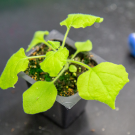
A promising new fungicide to fight devastating crop diseases has been identified by researchers at the University of California, Davis. The chemical, ebselen, prevented fungal infections in apples, grapes, strawberries, tomatoes and roses, and improved symptoms of pre-existing fungal infection in rice.
Plants have to be flexible to survive environmental changes, and the adaptive methods they deploy must often be as changeable as the shifts in climate and condition to which they adapt. To cope with drought, plant roots produce a water-repellent polymer called suberin that blocks water from flowing up towards the leaves, where it would quickly evaporate. Without suberin, the resulting water loss would be like leaving the tap running.
Sunflowers famously turn their faces to follow the sun as it crosses the sky. But how do sunflowers “see” the sun to follow it? New work from plant biologists at the University of California, Davis, published Oct. 31 in PLOS Biology, shows that they use a different, novel mechanism from that previously thought.
Scientists have long known that chloroplasts help plants turn the sun’s energy into food, but a new study, led by researchers in the Department of Plant Biology, shows that they’re also essential for plant immunity to viral and bacterial pathogens.
Faculty and staff in the college’s eight graduate groups, including Dan Kliebenstein from the Plant Biology Graduate Group, were among this year’s recipients of mentorship and service awards by Graduate Studies.
This year’s CBS Dean’s Mentorship Awards recipients, including Nathan Meier from Plant Biology, were honored at a college award ceremony on Saturday, June 3.
Two out of three professors, Luca Comai and Venkatesan Sundaresan, both from the Department of Plant Biology have been elected as members of the National Academy of Sciences.
In 1988, a 90-year-old alumna and former faculty member gave $648,000 to UC Davis to establish an endowment that would fund plant research fellowships in perpetuity. Still driving discovery today, her gift demonstrates the power of an endowment to benefit the world for generations.
An internal circadian clock controls the distinctive concentric rings of flowering in sunflowers, maximizing visits from pollinators, a new study from plant biologists at the University of California, Davis, shows. The work was published Jan. 13 in eLife.